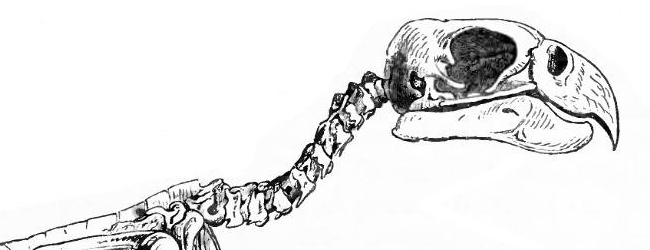
The new close relative of Kea parrots (Nestor notabilis) and Kaka parrots (Nestor meridionalis) was found by archeologists on Chatham Islands in the Pacific Ocean. This interesting discovery is based on an analysis of fossil parrot bones found on that place. Detailed study was published in the Zoological Journal of the Linnean Society. This small archipelago is a part of the New Zealand since 1842 and it’s about 800km distant. The bird got a name the Chatham Kaka (Nestor chathamensis).
a

Closely related Kea (Nestor notabilis). (c) Markus Koljonen. This file is licensed under the Creative Commons Attribution-Share Alike 3.0 Unported license.
a
Firstly, archeologists discovered fossils of a large parrot comming from the end of the 19th century. At that time Chatham Islands have been ihabited by immigrants from the New Zealand. Originally they thought that bones could belong to the Kea or even the Kakapo. We can find both species on the New Zealand and surrounding islands and both are endangered. The idea of a possibility that these bones can belong to a new species had arised in 1990 but hasn’t been developed then. The new study shows the morfological and molecular evidence about distinctiveness of the Chatham Kaka. However, it should be closely related to the Kaka.
“We suspect a lot of the previous confusion about the identity of the bones may have been due to the unusual proportions of the bird,” explained one of the researchers Jamie Wood for Landcare Research.
a

Another representative of Nestor genus, the Kaka (Nestor meridionalis). (c) Small. This file is licensed under the Creative Commons Attribution-Share Alike 2.0 Generic license.
a
“It would have looked superficially like a kaka, except its beak was halfway between the short beak of the kaka and the long beak of the kea. It also had large thigh bones and a broad pelvis, which suggests it spent a lot of time walking around on the ground.” Comparing of the Chatham Kaka DNA with the Kea and the Kaka DNA supports the idea that on phylogenetic tree this species is placed very near Kaka. This species probably colonized the islands 1,75 millions years ago, just after the vulcanic islands have showed above sea level.
The Chatham Kaka has extincted because of its large size and the inability to fly. The last bird died probably soon after the first immigrants arrived because they start hunting these birds immediately for their delicious meat. Several populations were surely threatened by invasive predators, mostly wild cats and rats. The Chatham Kaka is already the second extinct species of Nestor genus. The Norfolk Kaka (Nestor productus) has extincted at the same time. This parrot inhabited Norfolk and Phillip Islands. In this case, the last individual died in 1851 in the ZOO London.


 Speakers of the X. International Parrot Convention: ...
July 21st, 2022
Speakers of the X. International Parrot Convention: ...
July 21st, 2022
 Speakers of the X. International Parrot Convention: Ant...
June 13th, 2022
Speakers of the X. International Parrot Convention: Ant...
June 13th, 2022
 Speakers of the X. International Parrot Convention: Mar...
May 22nd, 2022
Speakers of the X. International Parrot Convention: Mar...
May 22nd, 2022
 Speakers of the X. International Parrot Convention: Ju...
May 16th, 2022
Speakers of the X. International Parrot Convention: Ju...
May 16th, 2022

 8k
8k 25k
25k

 18k
18k